This is the ISU archive | Back to Main
tobearchived after 6 years
Posted on Monday, September 17, 2012
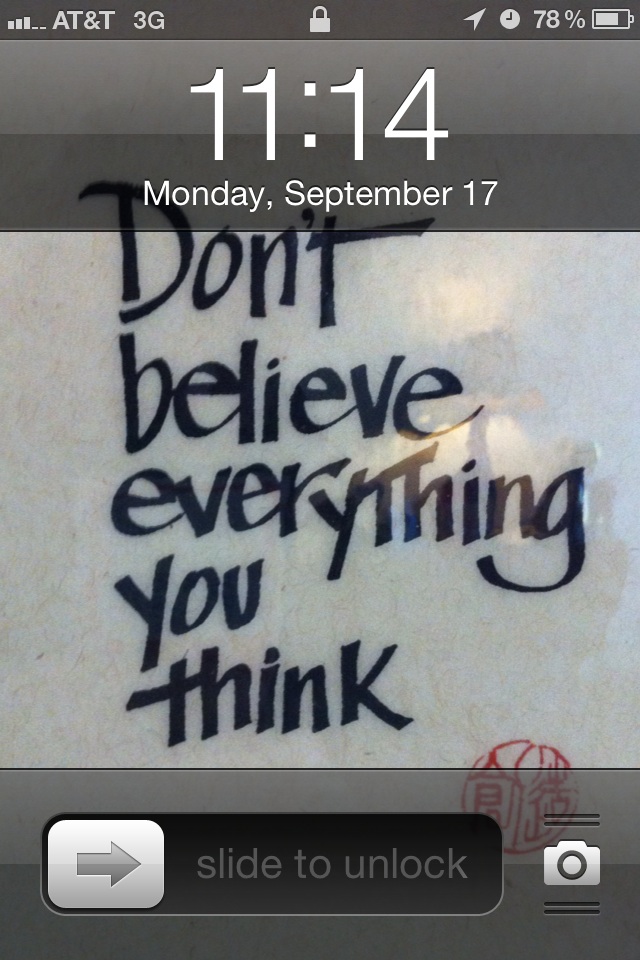
After exactly 6 years (first post) its time to archive this blog. I've had a great time keeping a trail of my online journeys over these past 6 years and it served me well in my worldly travels, but its time for a new itinerary. I will keep the content up for the Google but I won't be posting here anymore. If you're interested in staying connected, follow me on Twitter @tobedetermined until I find a new home to share my current and future travels.
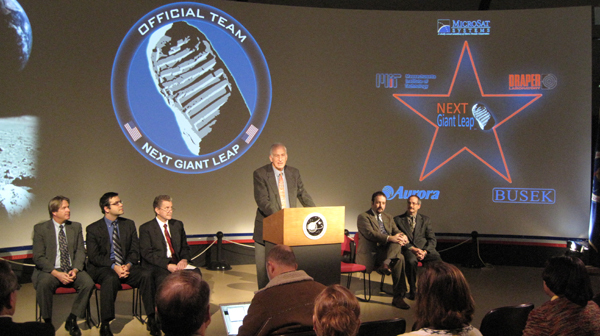
GLXP Mystery Team Reveals Itself at NASA Ames
Posted on Wednesday, December 17, 2008
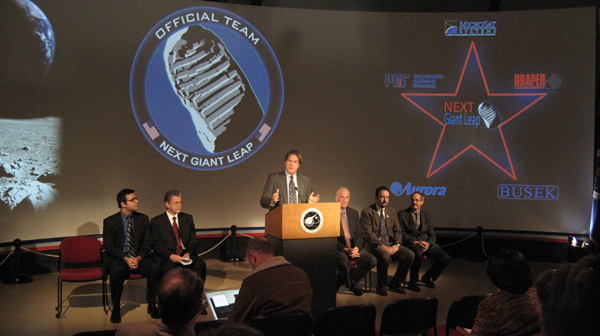
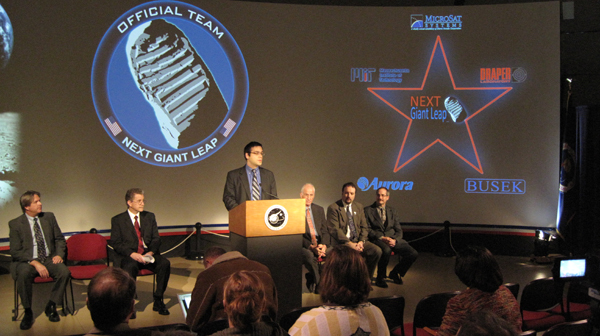
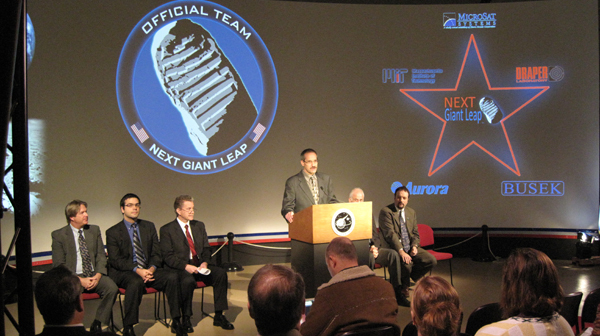
Earlier this morning, the GLXP Mystery Team revealed its identity here at the NASA Ames Research Center. From top to bottom its Gary Martin (Director of NASA Ames' New Ventures and Communications Directorate [aka Code V]), Will Pomerantz (X PRIZE Senior Director of Space Projects), MSI president John Roth Michael Joyce (Leading the now-not-a-mystery-team-anymore-but-called-Next-Giant-Leap team), and one of my favorite NASA astronauts Jeffrey Hoffman. More on the unveiling at CNET and more on the team's partners at the NGL website.

Lunar Lander Challenge Video
Posted on Sunday, November 9, 2008
A nice minimalistic beat and distortion of the onboard camera. More on the Lunar Lander Challenge (via).
International Committee on the 'Cultural Utilisation of Space' Launched
Posted on Friday, October 17, 2008
Reblogging Arts Catalyst:
The new IAF (International Astronautical Federation) Technical Activities Committee for the Cultural Utilisation of Space (ITACCUS) was announced during the Less Remote symposium. ITACCUS has been set up to promote and facilitate the innovative utilisation of space by the cultural sectors of society internationally. The term 'utilisation' is used often by the space community. In a cultural context, it may include cultural production, cultural preservation, cultural representation, cultural education and cultural development.The launch speakers were ITACCUS co-chairs Roger Malina, Director, L'Observatoire Astronomique Marseille, and Nicola Triscott, Director of The Arts Catalyst, and committee members Ciro Arevelo, Chairman of the United Nations Commitee on the Peaceful Uses of Outer Space, who welcomed the ITACCUS initiative for the contribution that the cultural sector could make to space and society's engagement with it, Mario Hernandez from UNESCO, who explained the work of UNESCO in using space surveillance systems to monitor world heritage sites, Bernard Foing from the European Space Agency and Spanish astronaut Pedro Duque.
ITACCUS will report on its activities online, and will submit a report annually on cultural utilisation of space to the UN Committee on the Peaceful Uses of Outer Space. It is developing a webspace, which will be linked from its page on the IAF website at www.iafastro.com.
10 Bucks Well Spend
Posted on Wednesday, September 24, 2008
Following on from yesterday's syndication of Tim O'Reilly's keynote at the NY Web2.0, I just finished watching the documentary he has been pointing out on several of his keynotes: A Crude Awakening: The Oil Crash. Buy it on itunes from their website and have a peak into the future of post cheap oil society. Quite informative...
Tim O'Reilly's Call to Action
Posted on Tuesday, September 23, 2008
And it ain't throwing sheeps. From last week's Web 2.0 Expo in New York entitled "Web Meets World".
(via)
tobedetermined.org Extended Credo
Posted on Monday, September 1, 2008
Update: A post over at O'Reilly Radar by Nat Torkington reminds me of another quote I've used in the earlier days of this blog. It's a (famous) quote from William Gibson: The future is here, its just not evenly distributed yet. In his post, Nat refers to another quote from Gibson that brings the overarching point home:
One of the things our grandchildren will find quaintest about us is that we distinguish the digital from the real, the virtual from the real. In the future, that will become literally impossible. The distinction between cyberspace and that which isn't cyberspace is going to be unimaginable. When I wrote Neuromancer in 1984, cyberspace already existed for some people, but they didn't spend all their time there. So cyberspace was there, and we were here. Now cyberspace is here for a lot of us, and there has become any state of relative nonconnectivity. There is where they don't have Wi-Fi.
Having a 3-day weekend does have its benefits (like in: having an extra evening behind your computer?). Think I just stumbled upon something like an extended credo for this blog (beyond tobedetermined.org: A blog about outer space, cyberspace, their common future and all that is leading up to it... ). I started gathering some quotes that resonated with me over the years and ended up with this list (read from top to bottom, in that order):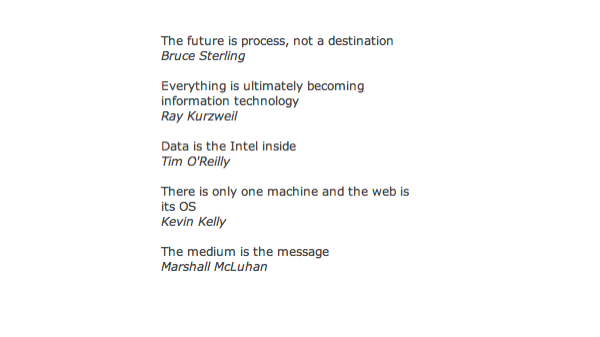
I am sure there are more out there that would fit this list, so if you have any suggestions pls let me know.
The Economist on Space
Posted on Thursday, August 21, 2008
Since reading the excellent 'Nasa at 50' in the Economist earlier this summer, I am considering them a valuable voice in the (online) space debate, so I am glad to see 3 new space articles in the 21st August edition (via):
Summer 2008
Posted on Friday, August 1, 2008
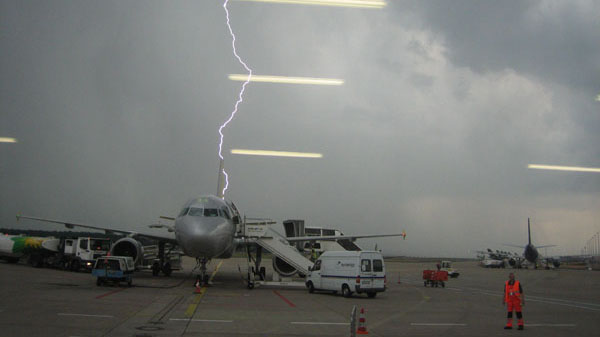
Back from a week of Internetless holiday on the island of Korcula (above photo was at Koln airport just before we were told we could board the plane ;-). Catching up here are a few relevant tidbits:
- The Economist's commentary on NASA's 50th anniversary provides a sharp dissection of NASA's past, present and future. Its the most sensible story on space and NASA I've read in a long while. As always, the comments are worth reading too, if only to see how space proponents bring their arguments into gear to downplay the article's 'hammer on the nail' analysis
- Sanfran article of the week about twitter, relationships, and the bay area working spirit
- Missed OSCON, but here's a 37min intro and Tim Oreilly's comments
- A great discovery: this TED video by kevin kelly. I especially like his McLuhan Reversal analogy. Have to watch it again.
S3 Outage Effects
Posted on Tuesday, July 22, 2008
Interesting. S3 goes out, and suddenly all over the web you'll see images disappearing, avatars evaporating and webshops go down.
Btw,for those who have the time to follow twitter feeds, and/or(?) are interested how we are gonna re-vamp NASA Ames' presence on the web (starting with the Ames page in the nasa.gov portal) we just added a new fly on the wall.
The Stone Age Didn't End Because of a Shortage of Stones
Posted on Sunday, July 20, 2008
Bruce Sterling comments inline on this passionate call by Al Gore for the US to become carbon fuel independent in 10 years.
Time to put some solar panels on my roof here in Palo Alto. Or wait, wasn't I first gonna spend 2 weeks flying around Europe for my holiday, buy the iPhone and upgrade my car (from what I hear SUV's come cheap these days).
Could this be the "Moonrace" of the 21st century?
We need you. And we need you now. We're committed to changing not just light bulbs, but laws. And laws will only change with leadership. On July 16, 1969, the United States of America was finally ready to meet President Kennedy's challenge of landing Americans on the moon. I will never forget standing beside my father a few miles from the launch site, waiting for the giant Saturn 5 rocket to lift Apollo 11 into the sky. I was a young man, 21 years old, who had graduated from college a month before and was enlisting in the United States Army three weeks later.I will never forget the inspiration of those minutes. The power and the vibration of the giant rocket's engines shook my entire body. As I watched the rocket rise, slowly at first and then with great speed, the sound was deafening. We craned our necks to follow its path until we were looking straight up into the air. And then four days later, I watched along with hundreds of millions of others around the world as Neil Armstrong took one small step to the surface of the moon and changed the history of the human race.
We must now lift our nation to reach another goal that will change history. Our entire civilization depends upon us now embarking on a new journey of exploration and discovery. Our success depends on our willingness as a people to undertake this journey and to complete it within 10 years. Once again, we have an opportunity to take a giant leap for humankind.
Yup
Posted on Thursday, July 17, 2008
Wading through +2k unread posts in my list of RSS feeds (Bruce Sterling's Beyond the Beyond).
Its You They're After
Posted on Saturday, July 12, 2008
The best analysis on Google's Lively I've read sofar comes from RealityPrime: Its not so much about giving people a nice virtual world to play with, its providing a new interface to harvest new and previously untapped user behaviour. Which reminds me of an excellent article I was send the other day on the near future of advertising, a must-read.
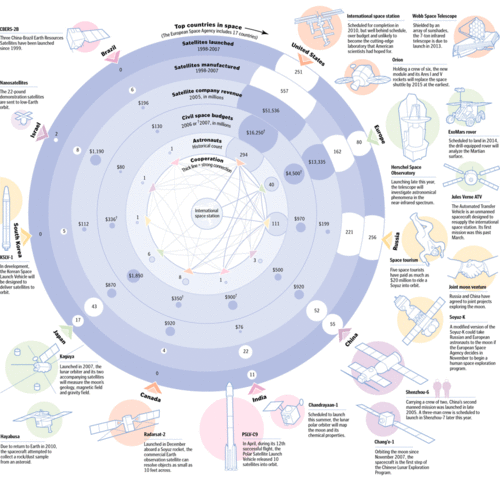
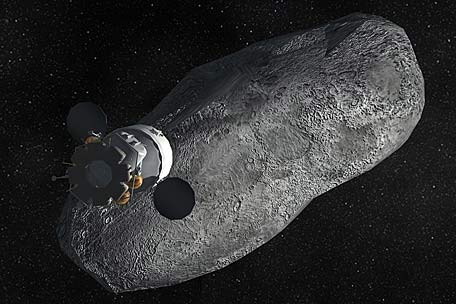
Excellent article on the Asteroid Underground movement here in the US
Posted on Saturday, June 21, 2008
In the July 2008 issue of the Smithsonian Air & Space Magazine: The Million Mile Mission. (via).
Friday Afternoon Yawns
Posted on Saturday, June 7, 2008
OgleEarth is on the ball with his critique on Walt Disney Park's layer in Google Earth being 'the next best thing to being there'. Reading it, I recognise I am reading my own unexpressed yawn about it (without having had a look at it myself I do admit, but that tells it all I guess). A virtual Disneyland devoid of people, and no possibility to take a ride, WoW!? If only I had some time to go back to the enthusiasm while working on UGO, but for some reason, its not that attractive at the moment. Even with the ability to bring it into the browser, which is pretty cool yes, apart from the techno fetish, there's at the moment not much occasional inspiration to throw time at Google Earth (apart from learning the javascript GE API implementation perhaps). Has anybody heard anything about Second Life lately btw?
On a more enthusiastic note, I attended the Google I/O conference 2 weeks ago here at Moscone West. Now that was exiting! Not so much from a Google Tech or developers point of view (albeit that was pretty inspiring too, mostly diving into the Google App Engine, on which I had my first encounter with the GE browser plugin), but more from a cultural real people point of view. Apparently they brought Google culture over from the Googleplex to the conference center. I lost my camera in the meantime so can't show you my pictures of all the beanbags, free food, and other goodies, but man, that's a sweet company culture (and flickr tags are there to prove it). And a young crowd too.
I recognised the same kind of culture here at Yahoo HQ earlier this week where we were sitting in on a meeting on the upcoming Yahoo Hackday. Working at a place where the coffee corner closes 30 minutes after lunch has been served (that's around 2:00pm folks), and where the cappucino comes out of a prefab instant-make coffee-crap-machine, I am all for Google joining the ranks here on the NASA Ames premises. And I certainly hope some of their culture bleeds over the fence into Ames, which I'm sure it will (not sure if i'll be around to witness it though as they only start building in 2013).
As usual, these high profile Google announcements draw quite a bit of cynical critisism from the likes of Bull's rambles, Valleywag and ZDNet but that's as yawn inspiring as the Disney layer in Google Earth.
My two cents for the weekend: Ask not what Google or Yahoo! can do for you, but what Google/Yahoo! culture can do to your space program.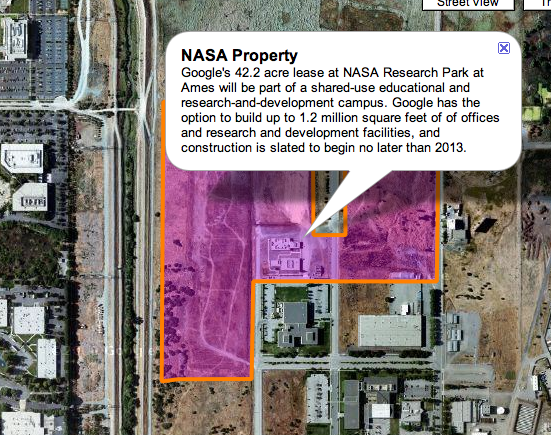
(see it in google maps, or, if you really really want to, in Google Earth)
View Larger Map
Mike Griffin at Googleplex (June 2007)
Posted on Saturday, May 17, 2008
Finally got a chance to see the recording of Mike Griffin's talk at the Googleplex last year. Informative talk. $55 a year per US citizen goes to NASA, out of an average 8k$ yearly tax bill. That's actually more than I'd expected.
World Wide Telescope Released
Posted on Thursday, May 15, 2008
Yep, its here (given the page design you'd mistake it for a Mac site just for a second). Ever since I upgraded to Mac OSX 10.5 (aka Leopard) last week my Parallels XP virtual machine is in a permanent state of reboot so I haven't had a personal interaction with WWT yet, but from the reviews of it over at OgleEarth and The Earth Is Square, it seems to be a pretty nifty application.
Can't wait to get my NASA Macbook Pro exchanged for a proper PC...
Some views to enjoy (until I get back to posting regularly)
Posted on Tuesday, May 6, 2008
Its busy times here at Ames...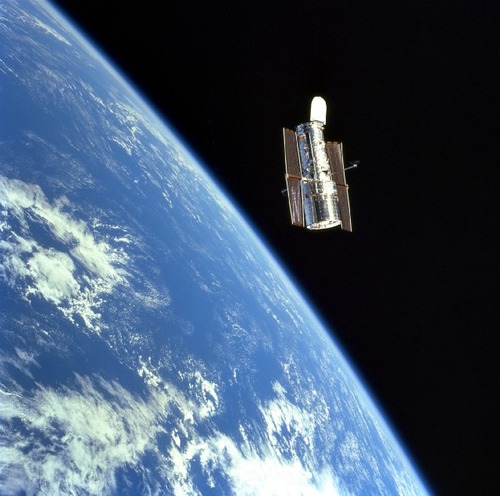
A.C. Clarke died today
Posted on Wednesday, March 19, 2008
...(bbc news)
update: Google's Chief Evangelist Vint Cerf also says goodbye to Clarke in this post. It includes a nice video of Clarke recorded end of last year.
Time to get on the bus
Posted on Wednesday, February 27, 2008

Ok, so its time to give a brief update on my (physical) whereabouts. Since last thursday I moved from Amsterdam to Mountain View, Silicon Valley to work with Chris Kemp and his collegues over at NASA Ames starting next monday March 3rd. Weehoo! Finally, a long held dream is coming true, taking part in the upcoming merger of outer space and cyberspace, right at the heart of where all things space are happening. Couldn't be better!
As for this blog, looks like I will be using it from now on to give you a personal insight in my personal and professional experiences here in the Valley. Sofar, these include a great arrival and first few days enjoying the Bay Area rainy season (yes, it can rain here...), a visit to the Vertical Motion Simulator on NASA Ames premises last friday (for photos have a look at this flickr album), my first NASA vrimibo with Ames director Pete Worden, Chris Kemp and several of my upcoming collegues (vrimibo is short for 'vrijdag middag borrel', Dutch for the traditional friday afternoon drink), a first counter-clockwise drive around the Bay Area, and writing off the first item on my wishlist of things-to-do-when-I-get-to-the-Bay-Area: attending a Long Now seminar in San Francisco (on which more in a follow-up post).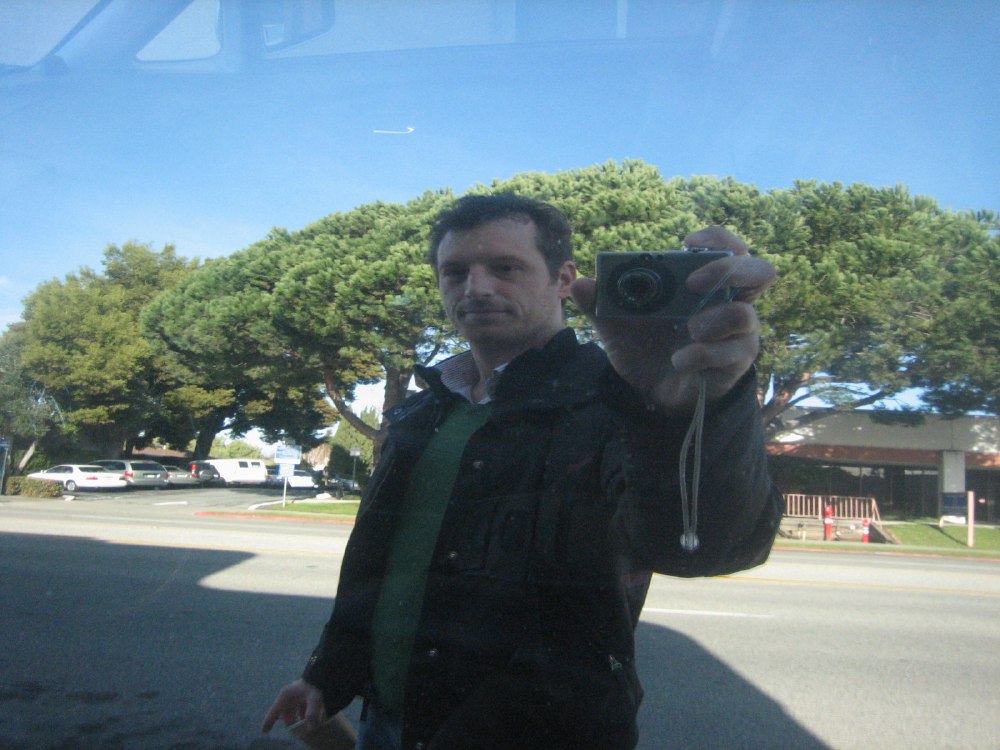
SpaceCollective.org
Posted on Monday, February 11, 2008

Techno utopianism lives on. Its been a while since we heard from Kurzweil, but I recently came across this website called spacecollective.org, set up by former country man Rene Daalder. From a first peek, it seems to be along the lines of what this blog is all about, that is, evolution of technology and the role of space in this evolution. Spacecollective.org seems to have a healthy critical stance, definitely worth a visit. I like the fact it originates from someone in the film industry, one of the main story telling industries out there and a long time passion of mine. Like the Peppers used to sing:
Space may be the final frontier
But it's made in a Hollywood basement.
Columbus is in orbit
Posted on Thursday, February 7, 2008
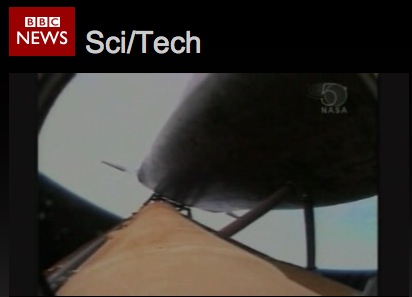
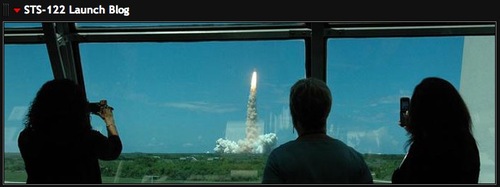
Congratulations to everybody involved!
More at:
NASA STS-122 blog
BBC news (10 min video)
The Medium is the Mind
Posted on Saturday, January 19, 2008
Another good reason why to read below book, the following quote comes from the author's blog:
"The medium is the mind," I write toward the end of The Big Switch, arguing, as others have before, that the tools we use to gather, store, and analyze information inevitably exert a strong influence over the way we think. As the internet becomes our universal medium - what the director of the Annenberg Center for the Digital Future terms "a comprehensive tool that Americans are using to touch the world" - its technical characteristics also begin to shape, slowly but inexorably, the workings of our memory and our other cognitive processes.
Solar Cycle 24
Posted on Thursday, January 10, 2008
Some topics passing by:
- In case you missed it, Solar Cycle 24 just started
- MDA (Canada's biggest satellite business) gets sold to US defense contractor
- The Arts Catalyst blog has recently emerged. From their blog:
The Arts Catalyst commissions art that experimentally and critically engages with science. We bring together people across the art/science divide and beyond to explore science in its wider social, political and cultural contexts. We produce provocative, playful, risk-taking projects to spark dynamic conversations about our changing world.
- A lot of good text over at Edge, following this year's question 'What have you changed your mind about? why?'. Sofar, this entry by Douglas Rushkoff stood out:
The Internet
I thought that it would change people. I thought it would allow us to build a new world through which we could model new behaviors, values, and relationships. In the 90's, I thought the experience of going online for the first time would change a person's consciousness as much as if they had dropped acid in the 60's.
I thought Amazon.com was a ridiculous idea, and that the Internet would shrug off business as easily as it did its original Defense Department minders.
For now, at least, it's turned out to be different.
Virtual worlds like Second Life have been reduced to market opportunities: advertisers from banks to soft drinks purchase space and create fake characters, while kids (and Chinese digital sweatshop laborers) earn "play money" in the game only to sell it to lazier players on eBay for real cash.
The businesspeople running Facebook and MySpace are rivaled only by the members of these online "communities" in their willingness to surrender their identities and ideals for a buck, a click-through, or a better market valuation.
The open source ethos has been reinterpreted through the lens of corporatism as "crowd sourcing" — meaning just another way to get people to do work for no compensation. And even "file-sharing" has been reduced to a frenzy of acquisition that has less to do with music than it does the ever-expanding hard drives of successive iPods.
Sadly, cyberspace has become just another place to do business. The question is no longer how browsing the Internet changes the way we look at the world; it's which browser we'll be using to buy and sell stuff in the same old world.
ISU2
Posted on Tuesday, November 27, 2007
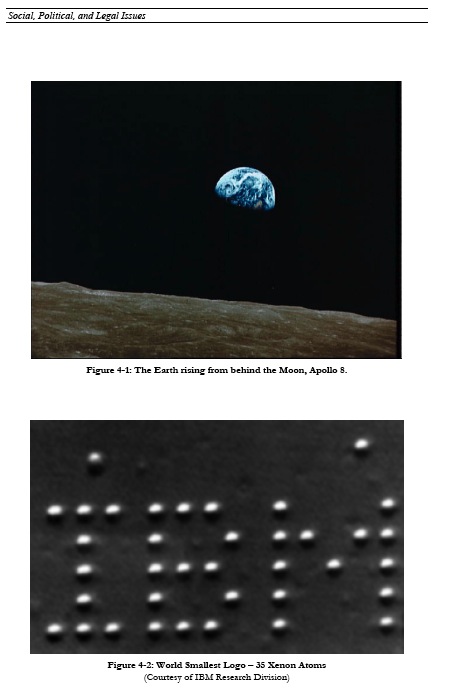
Erik Laan points me to this post about the ISU2 working meeting held at Ames Research Center yesterday and today:
The ISU-2 Working Meeting is being hosted by NASA Ames Research Center to bring together key individuals to brainstorm the concept of the International Singularity University (ISU2) and to answer certain fundamental questions and plan for a "Founders Conference" expected in Spring 2008 and an inaugural Summer Program in 2009 in the Bay Area.International Singularity University (ISU2) which would educate attendees on the history, current status, trends and projected futures of these technologies. ISU2 will facilitate students to form networks, study the implications of exponentially advancing technologies (nano, bio, AI, etc), the cross-disciplinary interactions, and legal, policy and societal implications which will result. ISU2 would be modeled on the concepts and practices pioneered by the International Space University (ISU) during its past 20 years of operation (1987 - 2007).
Date: 26-27 Nov 2007
Location: NASA Ames Research Center, Moffett Field, CA, US
Web Site Address: http://www.arc.nasa.gov
Way to go Ames! I am an alumni of ISU1, that is, the International Space University, where I participated in the '06 summer session Team Project dealing the impact of Micro & Nano Technologies for space so I am thrilled to see the ISU formula being applied to a topic that is close to my heart. In fact, I think I'd gladly follow the ISU-2 summer session cause it'll have a lot of interesting ground to cover. And Silicon Valley is the right place to be when it comes to the Singularity. ISU1 summer session 2009 is already scheduled to be hosted at Ames so '09 promises to become a truly remarkable summer over in Mountain View.
Google Space Agency
Posted on Monday, November 26, 2007
A quick backlog of links related to the Google NASA coop. They're working on it down at Ames in what is called the 'Planetary Content Team' (nice title):
The Planetary Content Team at NASA's Ames Research Center develops software that makes it easier for scientists and engineers to publish and access Earth and planetary imagery and data via the Internet. This includes both educational/outreach content aimed at the general public as well as technical data aimed at the scientific community. Headquartered in the Intelligent Systems Division at Ames, the team also includes partners in other areas of the agency and elsewhere.
They do both the NASA Google Moon work (Google maps only sofar but they're working on a Google
“NASA’s objective is for Google Moon to become a more accurate and useful lunar mapping platform that will be a foundation for future Web-based moon applications, much like the many applications that have been built on top of Google Maps,” said Chris C. Kemp, director of strategic business development at NASA Ames. “This will make it easier for scientists everywhere to make lunar data more available and accessible.”That's gonna come in handy when the robots are going to land on the Moon in the decades to come.
View Larger Map
Space Explo's Value Propositions
Posted on Monday, November 19, 2007
The Register today writes under the title 'Americans clueless on NASA budgets' :
A recent survey, carried out on behalf of The Space Review, has revealed that the average American believes a quarter of the country's public purse goes towards funding NASA.Unfortunately, The Register gets its facts wrong because the survey was never conducted on behalf of The Space Review but merely written about on The Space Review, which happens to be one of the more interesting space blogs to read out there (together with NASA Watch and spacecynics). Going to the original article quoted above, I find 2 great articles on space exploration, relevance and customer value: Part 1 and Part 2. On the spot! It's a relief to read this as it provides a pretty clear cut picture of space exploration and its place in modern day consumer market thinking:
The survey found that most people reported the belief that NASA is almost as well funded as the military. The Department of Defense does receive roughly 21 per cent of the nation's wonga, but most people overestimated this by a further 12 per cent.In reality, NASA gets something like 0.6 per cent of the natonal budget, a fact which researchers report came as a surprise to those being surveyed. According to The Space Review, one participant replied "No wonder we haven’t gone anywhere!".
The survey formed part of a larger analysis of the costs and benefits of having a publically funded space agency. The writers argue that people have scant knowledge of what NASA actually does. Combined with the huge overestimates of the cost of running NASA, it is not surprising that people often regard it as being poor value for money.
 .
.
Some thoughts following the Space Explo Conference
Posted on Tuesday, November 13, 2007
Update 15 November: I was told at ESTEC today that videos of the conference will indeed be posted lateron once they are finished with the editing.
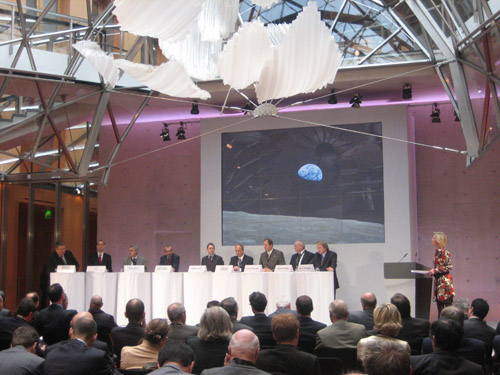
I went down to Berlin last week to attend an ESA/DLR conference on the future of Space Explo in Europe. A lot was said, presentations were abundant, and the various stakeholders (in particular politicians, space agencies and industry) gave their view on what Europe should be doing in the years to come on space explo. One of the main outcomes of the conference: the European Space Exploration Strategy has been reworded to the European Space Exploration Programme...he, these things can make a world of difference.
Interestingly enough, the M word, as in Moon, is still hard to pronounce by Mr. Sacotte of ESA as the agency has decided it should focus on the Mars. Seems this is a position they took when NASA was fully engaged with Mars exploration back in the early 00's. However, since then, Bush has redirected the NASA strategy towards bringing humans back to the Moon, and it seems hard for ESA to bring its strategy in line with this redirected global explo agenda. So while all countries pulling any weight in the space explo arena, China, India, the US of A, all have their focus on the Moon, Europe seems to be struggling with their lock-in in thinking about the Mars (the English pronounceation of native German speakers brings some funny mashups, as in talking about the Moon vs talking about the Mars). Germany however isn't fooled and recently announced its plans to develop a national lunar probe, something that was re-iterated at the conference by DLR Director of Space Programmes Mr. Dollinger.
There was a point where I got intruiged about the way they talked about the usual dichotomy between robotic (unmanned) and human exploration. Usually, this debate quickly ends in the trenches where the proponent on either side digs him/herself in with the usual arguments, leading nowhere. A first smart remark in this context I remember from US astronaut Jeffry Hoffman (of Hubble repair fame) who made the comment at ISU about the complementariness of humans and robots (I don't remember his complete argument, but given that he went up to space to repair a robotic explorer kind of paints the picture of his understanding). At this conference, there was the same question on the table. On itself an interesting question and space is one of the few places where this comes up all the time due to the shear costs involved in sending humans up. This time, it felt as if the conference participants, all human to my knowledge, where there to make a strong case for human exploration...because all of us attending were human. It seemed there was a stance in the robotic/human debate about us against them. Its the first time I interpreteted the debate this way, but it makes for an interesting perspective on where things might be going. The drive to explore doesn't change, its the means that are under scrutiny. Another argument in this context, one that I made together with an ISU collegue last year at a presentation was the following: the most efficient space suit is one without a human inside.
Another important topic which seemed to come up every 5 minutes during the conference was the need for communication of why Europe needs to take part in this global exploration agenda. Well, I guess its true then. The 'Artist as Space Explorer' space & the arts exhibition was nice in that respect but I had a strong deja vu of some 7 years ago when I was involved in a similar type of set up for ESA and the exhibition was mainly used as decoration around the bar with free champagne. Not that different here. Still, it appears there is a little seed taking root at ESA. Hope they'll let it grow...
If this were the web2.0 Summit held in San Francisco last month, the presentation videos would have been online by now. But this is a meeting of much less importance so no videos yet (space exploration...wasn't that something with Apollo?). I really hope they put some videos of the conference online, but given ESA's track record of keeping the walls high and dry, I have my doubts. I'll certainly address it when I get to ESTEC this week. Also in terms of putting the presentations online. If you're interested to put some faces to names, have a look at the flickr photoset I uploaded with the main talking heads. Below pictures were from a presentation by astrophysicist Hans-Joachim Blome about the Cultural Dimension of Human Spaceflight and Exploration. He managed to stay out of the usual paths and gave a glimpse at exploration from a scientific evolutionary point of view. I hope to receive his presentation later this week so I can post it here. 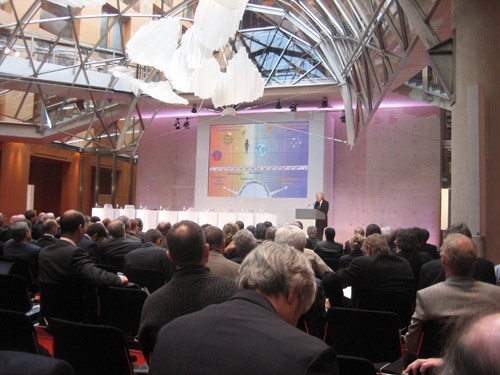
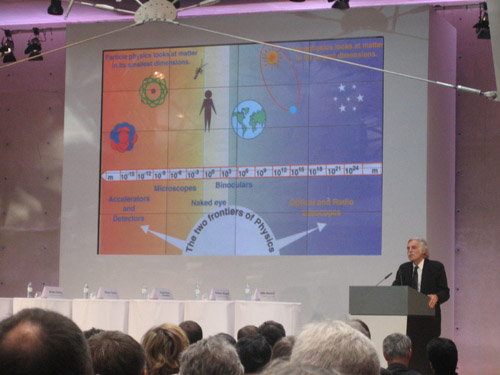
DinnerTV: 30min. of the Google Guys @ Zeitgeist 2007
Posted on Sunday, October 21, 2007
Zeitgeist 2007 (below is the Youtube video). @ 9:54 Larry Page talks briefly about Google's involvement in the X-Prize, @ 17:32 Esther Dyson hints at inner space (i.e. healthcare) being a more interesting market than outer space:
Outer space is really cool but I am not sure how much Google can do with it.(via SearchEngineLand)
Sign up now: your 7-day excursion to on the Moon
Posted on Sunday, September 30, 2007
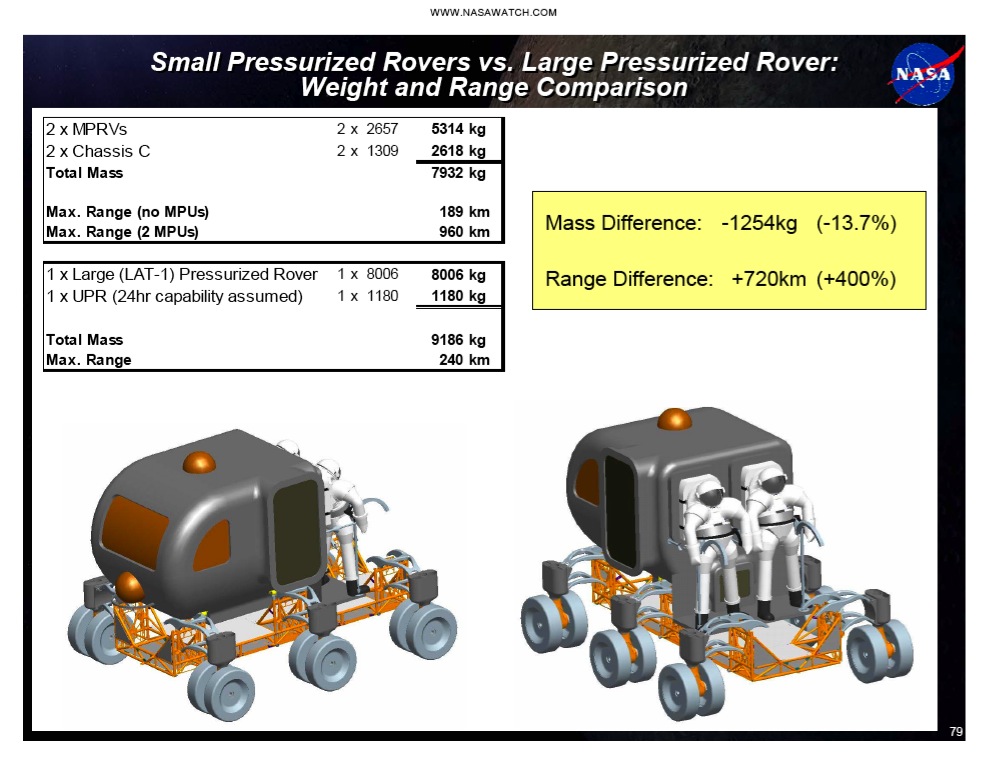
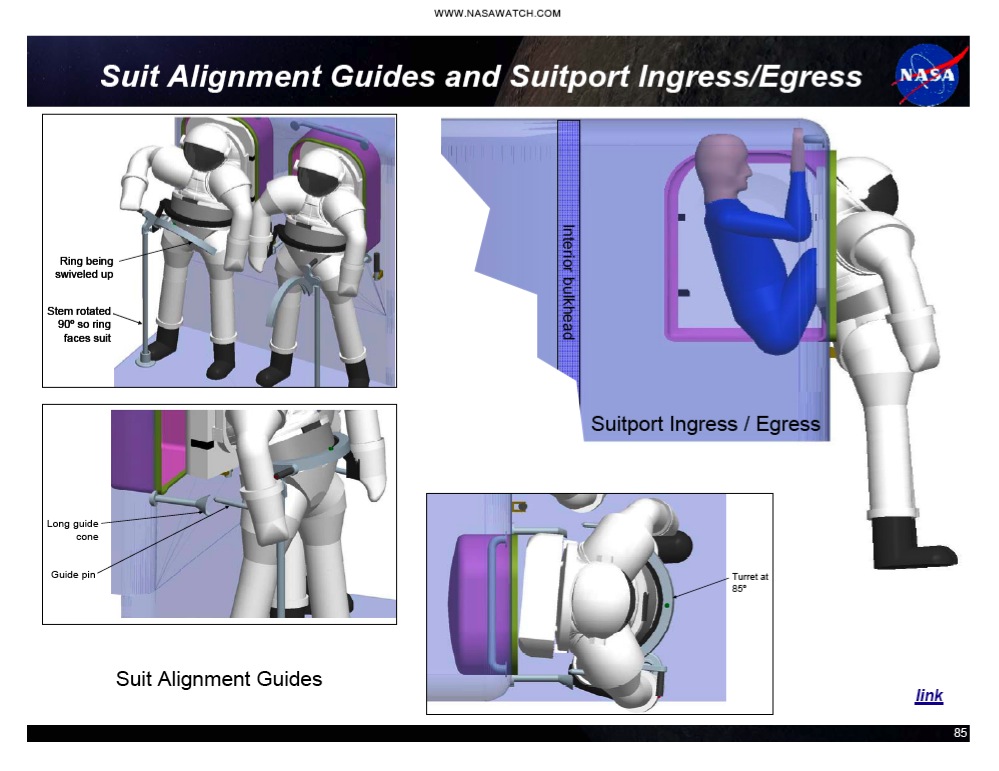
Doing some overdue reading on developments in the space explo arena, I am struck by below slides depicting an assessment of possible Lunar sorties in NASA's latest Lunar Architecture update (Sep'07). They give a pretty good first grasp of the distances involved when future astronauts r gonna have a great time driving around the Lunar surface with their Moon buggies. Looking forward to joining them near real time from behind my computer (with only a 1.5 sec lightspeed delay). Another report text worth a look at is the Global Exploration Strategy (May'07) as it provides an interesting (albeit somewhat romantic) view of space explo in an effort to globally coordinate space exploration agendas into a global exploration strategy. Harnessing the collective space intelligence...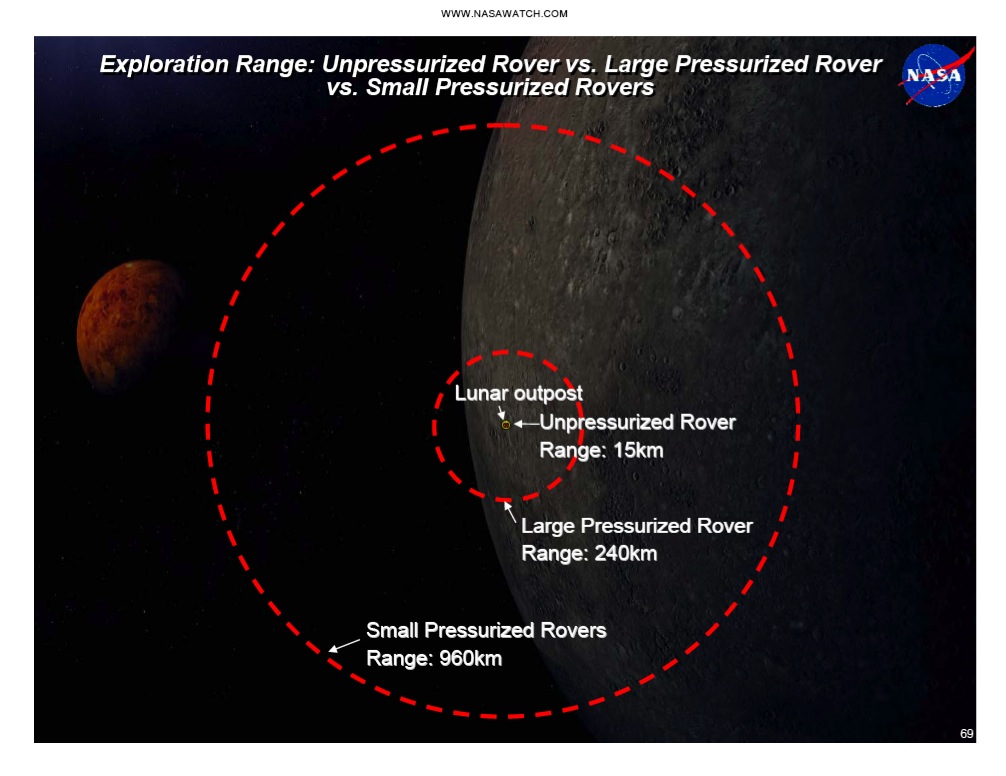 ;br>
;br>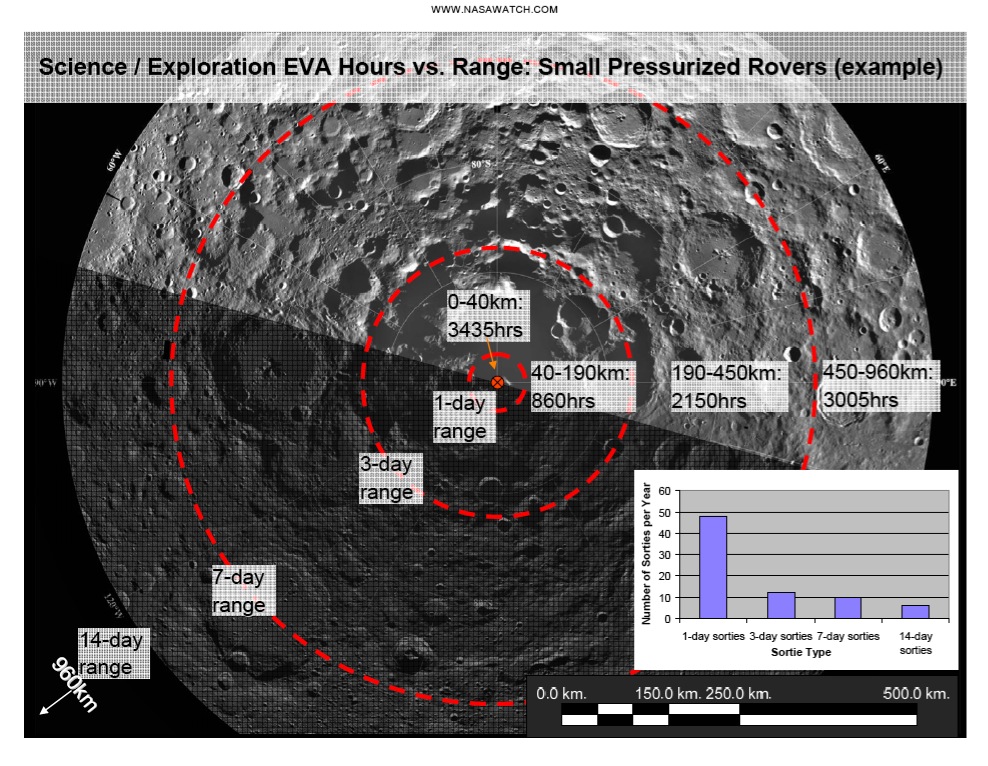
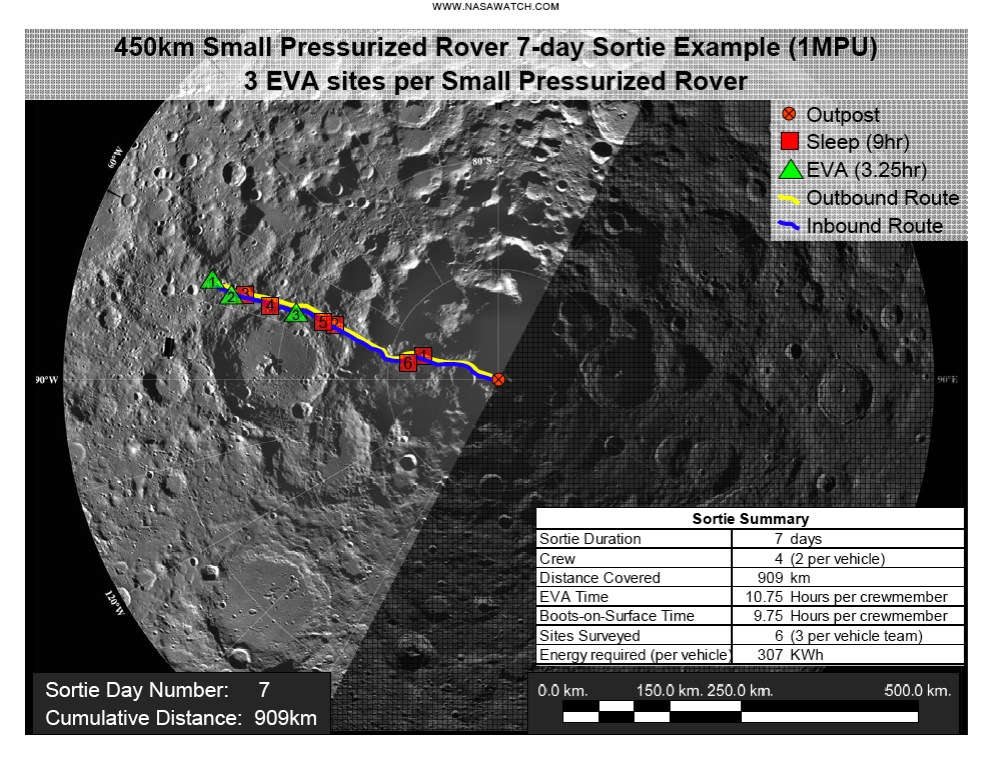
Evolutionary benefit from Space Explo
Posted on Thursday, September 20, 2007
Reading up on the Google Lunar X Prize at the BBC I come across this quote from Peter Diamandis, X Prize founder (and ISU founder):
"We are confident that teams from around the world will help develop new robotic and virtual presence technology, which will dramatically reduce the cost of space exploration," said Dr Peter Diamandis, chairman of the X-Prize Foundation in a statement.Working in the space business, one question that keeps me busy these days is trying to understand which of the technologies to be developed for the "space race to come" will influence society on the long run. Computer chips have gained evolutionary benefit from both the military (nuclear missile guidance systems) and the '60 space race (Apollo descent stage). If history accounts for anything, it is pretty clear spin offs from endeavours such as space exploration will play out in society in unexpected ways. With the X-prize's emphasis on robotic exploration and telepresence technologies, I bet you there will be more of this fusing into society in the decades ahead, the question is only how exactly. By the time space exploration gets anywhere, I doubt we will experience the world as we do today.
Today's NASA Slogan: All Your Space Are Belong To U.S.
Posted on Sunday, September 9, 2007
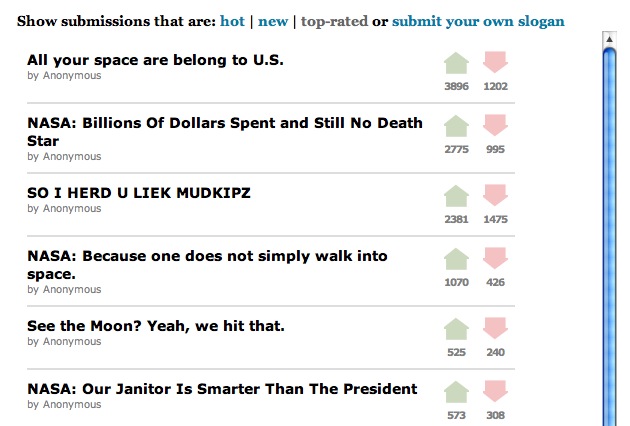
Wired is running a crowdsurfing NASA slogan contest to see if its readers can come up with a better slogan than the recently selected "NASA explores for answers that power our future". Starting out as a gimmicky blogpost (read a long list of proposed-slogans-as-comments here), the large number of entries have moved the contest to a more sophisticated system (the NASA Slogan Reddit Tool!) where people can cast votes on the various entries. Above image shows the top-6 of today, Sunday September 9th 2007.
Sofar, many of the proposed slogans go back to NASA's glorious past, poking fun at present-day achievements. With the CEV vehicle (aka Orion) resembling Apollo all the way down to the parachuted landing (water or land, what does it really matter?), having a slogan referring to the successes of the past seems to me to match NASA's own state of mind (yep, its the the wisdom of crowds allright). In that sense, having a slogan bringing back the glory days of NASA isn't all that far fetched if you ask me...I mean, how inspirational is this graph: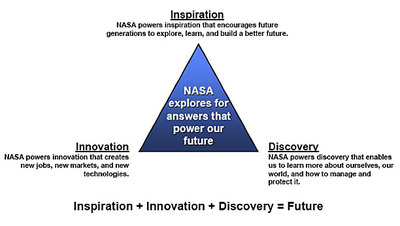
compared to this image: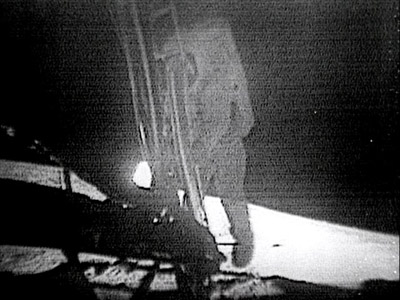
Would be nice to have the WIRED contest run indefinite while NASA's Vision for Space Exploration unfolds, having something like a NASA Slogan Zeitgeist over the coming decades. Btw, if you're interested, some more background information on NASA Strategic Communications can be found in this powerpoint pdf.
SciFoo
Posted on Thursday, August 9, 2007

Update from Duncan Hull (keep me posted Duncan!):
There is talk of EuroFoo, probably to be held in Cambridge. There will also be "bar camps" again, in Cambridge and soon in Manchester.
Man, I wish they'd bring SciFoo over to Europe, how cool is this ? To get a taste, have a look at this Flickr series ! Maybe a SpaceFoo? Probably a bit too exciting for ESA, but ISU perhaps?
Light posting ahead
Posted on Saturday, May 12, 2007
Haven't been very active on this blog lately, which is mainly due to my full focus on the development of my UGO project, making me less susceptible to reading my section of the blogosphere on all the news coming out on a daily basis. I haven't finished my first build yet, so this light posting will likely continue for the coming days/weeks untill I finalise a first UGO app. In the meantime, some interesting developments worth noting:
- Search Engine Land (definitely a good read)
- a joke
- Anil Dash post
- News.com
And of course there is the news of a new WorldWind JAVA release.
Updated blog feed
Posted on Tuesday, May 1, 2007
Mmm, turns out I already had a FeedBurner account with several subscribed readers to this blog (re: earlier post). Strange how things like feeds can get this complicated...;) Anyway, to keep things organised I decided to delete the new account and merge its feed with the already existing one. For those of you who subscribed to the new one in recent weeks, please visit my blog's webpage and (re)-subscribe one more time to the FeedBurner link on the right.
To check if you have the correct feed, the correct FeedBurner account should now have the following URL: http://feeds.feedburner.com/tobedetermined (for Safari on OSX this should read: feed://feeds.feedburner.com/tobedetermined)
Thanx again...
tobedetermined finds...
Posted on Tuesday, November 28, 2006
- Swedish space art
- web3.0 here we go...and here too.0
- ISU's Space Odyssey Institute to launch at the ISU Summer Session in Beijing
- ISU's 11th Annual International Symposium "Why the Moon?"
- Point to the sky and the SkyScout will tell you what you are looking at
- The SpaceNavigator, a new 3D mouse for virtual globes like Google Earth
The future is process, not a destination
Bruce Sterling
Everything is ultimately becoming information technology
Ray Kurzweil
Data is the Intel inside
Tim O'Reilly
There is only one machine and the web is its OS
Kevin Kelly
The medium is the message
Marshall McLuhan